Reviewing Emerald Embroidery Sequin Fabric Paper
As an embroidery designer who has spent years translating digital concepts into tangible, stitched realities for small businesses, I approach every new asset with a critical eye. We are not just making pretty pictures; we are building brand identity through thread and fabric. Recently, I evaluated Emerald Embroidery Sequin Fabric Paper to determine its viability for commercial use in branded merchandise. This is not merely a decorative element; it is a potential cornerstone for boutique branding, provided it is applied with technical precision.
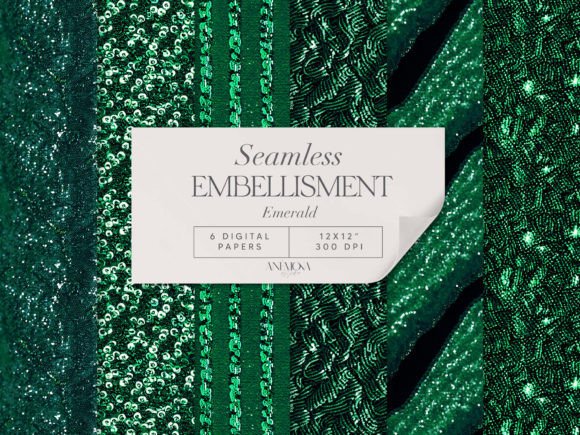
The product description introduces us to Anemona Estudio, offering six luxury digital papers in JPG format at 300 dpi. These are RGB seamless files, 3600px wide, which translates to a substantial 12 inches of high-resolution detail. For those of us working in the realm of Patterns and Graphics, this resolution is crucial. It allows for deep zooming and detailed inspection before we even touch the sewing machine. But does this digital asset translate well to the physical world of custom apparel and hard-wearing goods?
First Impressions: Visual Personality and Brand Fit
The first thing that strikes me about Emerald Embroidery Sequin Fabric Paper is its inherent sense of luxury. The title alone suggests a blend of organic richness—emerald—and tactile glamour—sequins. In a business context, this visual personality leans heavily toward premium, elegant, and celebratory. It is not rustic or understated; it is bold and decorative.
For a handmade brand or a creative studio, this aesthetic can elevate perceived value instantly. Imagine a local florist using this motif on their wrapping paper or as a background for their social media graphics. The "sequin" aspect implies light reflection and movement, which can be mimicked in embroidery through the strategic use of metallic threads or high-sheen rayon. However, because this is a digital paper and not a vector-based machine embroidery design file, our job is to interpret this visual cue into stitch language. We must decide if we are printing this directly onto transfer paper for heat pressing or using it as a reference to create a custom embroidered patch.
Real-World Applications for Small Business Merch
Let us move beyond theory and look at how Emerald Embroidery Sequin Fabric Paper performs in real business scenarios. I envision this design working exceptionally well for specific niches:
- Boutique Merchandise: A high-end clothing boutique could use this pattern as a lining for tote bags or as a printed accent on hang tags. The seamless nature of the file means you can tile it endlessly without visible breaks, creating a cohesive look for packaging.
- Event Merch: For bridal shops or event planners, the emerald and sequin theme is perfect for bachelorette party favors or wedding coordinator aprons. It screams celebration.
- Café and Bakery Branding: While perhaps too glamorous for a daily work uniform, this could be stunning on limited-edition merchandise, such as holiday-themed tote bags or special edition gift boxes.
When considering apron embroidery or cap embroidery, we must remember that this is a raster image (JPG). To use it for stitching, we would typically need to digitize a simplified version of the pattern. The rich green tones provide excellent contrast against neutral fabrics like cream, beige, or even black. For a tote bag design, printing this high-resolution JPG directly onto canvas via sublimation or direct-to-garment printing is a viable route that preserves the intricate "sequin" detail that might be lost in stitching.
Technical Constraints and Careful Usage
Here is where my experience as a designer demands caution. Emerald Embroidery Sequin Fabric Paper is visually complex. If you attempt to translate every pixel of this sequin texture into stitches, you will run into immediate problems with stitch density. High density leads to puckering, needle breaks, and a stiff, cardboard-like feel in the finished product.
There are specific areas where this design should be used carefully:
- Small Patch Sizes: At sizes under 2 inches, the intricate details of the sequin pattern will merge into a blob of green thread. It lacks the negative space required for legibility at small scales.
- Curved Surfaces: Applying a dense, heavy design to the front of a cap or a curved sleeve requires expert stabilization. Without proper backing, the fabric will distort.
- Textured Fabric: If you are stitching onto terry cloth towels or thick denim, the subtle gradients of the emerald color may get lost in the pile of the fabric.
- Frequent Washing: Items like staff uniforms undergo rigorous laundering. Complex, dense embroidery can fray faster than simpler designs. Ensure your thread colors are colorfast and your stabilizer is cut-away for durability.
Furthermore, since the provided files are JPGs in RGB color mode, they are optimized for screens, not necessarily for print or stitch conversion without adjustment. CMYK conversion for printing may shift that vibrant emerald to a duller forest green. Always request a physical proof or print a test sheet before committing to a large run of small business merch.
Impact on Brand Identity and Customer Trust
Consistency is the bedrock of brand identity. Using a high-quality asset like Emerald Embroidery Sequin Fabric Paper signals to your customers that you care about aesthetics. When a customer receives a package wrapped in paper featuring this lush, seamless pattern, or sees a tote bag with a coordinated design, it builds trust. It suggests professionalism and attention to detail.
For Etsy sellers and crafters, visual consistency across your design assets—from your digital shop banners to your physical product labels—creates a memorable brand experience. This particular design helps establish a vibe of luxury and care. It differentiates your handmade product from mass-produced competitors. However, this only works if the execution matches the promise of the design. A poorly stitched interpretation of this elegant pattern can damage credibility rather than enhance it.
Practical Designer Notes for Production
Before you integrate Emerald Embroidery Sequin Fabric Paper into your next commercial embroidery project, follow these practical steps:
First, test the visual impact in black and white. If the pattern loses its definition without color, it relies too heavily on hue rather than form. This is a good indicator of whether it will work as a subtle tonal embroidery or if it needs bold contrast.
Second, check the licensing. The description mentions "Perfect illustrations for all designs," but always confirm if the license covers physical resale of items made using the pattern, especially if you are printing the JPG directly onto products. Clarify if it is for personal use or commercial embroidery rights.
Third, create a printable mockup. Place the 3600px wide image into your design software and scale it to the actual size of your intended hoop or print area. Inspect it at 100% zoom. Are the edges clean? Is the resolution holding up?
Finally, consider your hoop size and stabilizer. If you are digitizing a derivative design based on this paper, choose a stabilizer that matches the weight of your fabric. For stretchy jersey tees, use a cut-away stabilizer. For woven cotton tote bags, a tear-away might suffice for lighter densities, but given the "sequin" implication, a denser stitch may require more support.
In conclusion, Emerald Embroidery Sequin Fabric Paper is a powerful tool in the arsenal of a modern maker. It bridges the gap between digital Graphics and physical texture. By respecting its technical limitations and leveraging its aesthetic strengths, you can create branded merchandise that truly stands out in a crowded market.